Amsterdam Business Forum 2026 in 7 quotes
Amsterdam Business Forum 2026 is a wrap. Discover 7 powerful lessons on People Centered Leadership, with practical takeaways you can apply right away.

It’s a wrap: Amsterdam Business Forum 2026.
And! What! A! Day! It! Was! We’ve captured every lesson on People Centered Leadership for you in 7 quotes. With the thinking behind each one and a practical lesson per speaker, so you can put them to work first thing Monday morning.
But first, let’s bask in the afterglow a little longer. With bubbles.
🤩 6 ANNOUNCED SPEAKERS AND 1 SURPRISE GUEST ON CURIOSITY, HUMANITY, COURAGE, AND THE CHOICES LEADERS MAKE EVERY DAY (with more lessons than we can count right now)
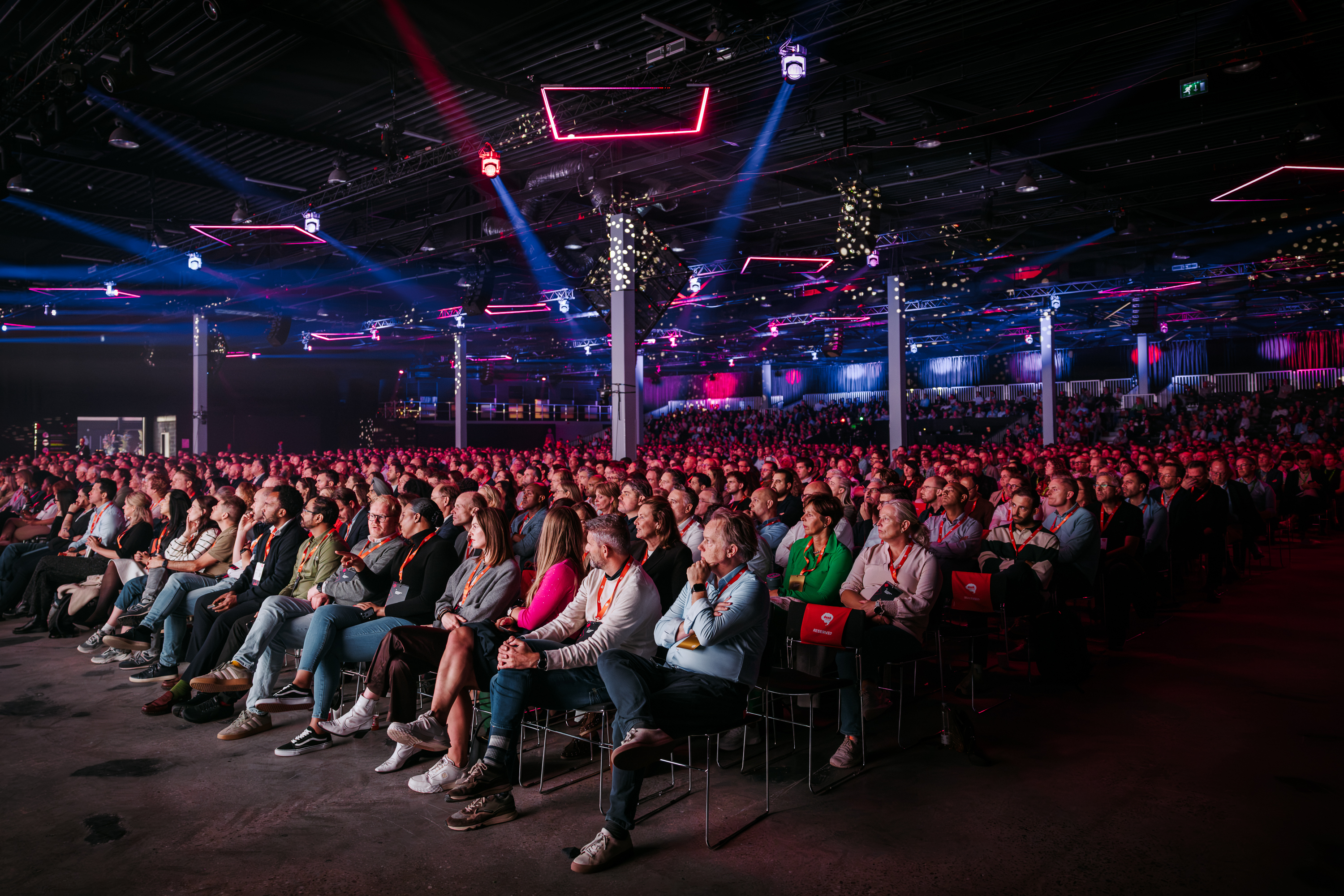
🤩 3,000 LEADERS AND ENTREPRENEURS WHO KEPT TALKING ALL THE WAY TO THE COAT CHECK (at a venue that was brand new to us)
🤩 AND IKENNA AZUIKE, THE BEST HOST OUT THERE, TYING IT ALL TOGETHER (and how!)
Right. On to the quotes, exactly as they sounded on stage.
Block 1: the human role in digital organizations
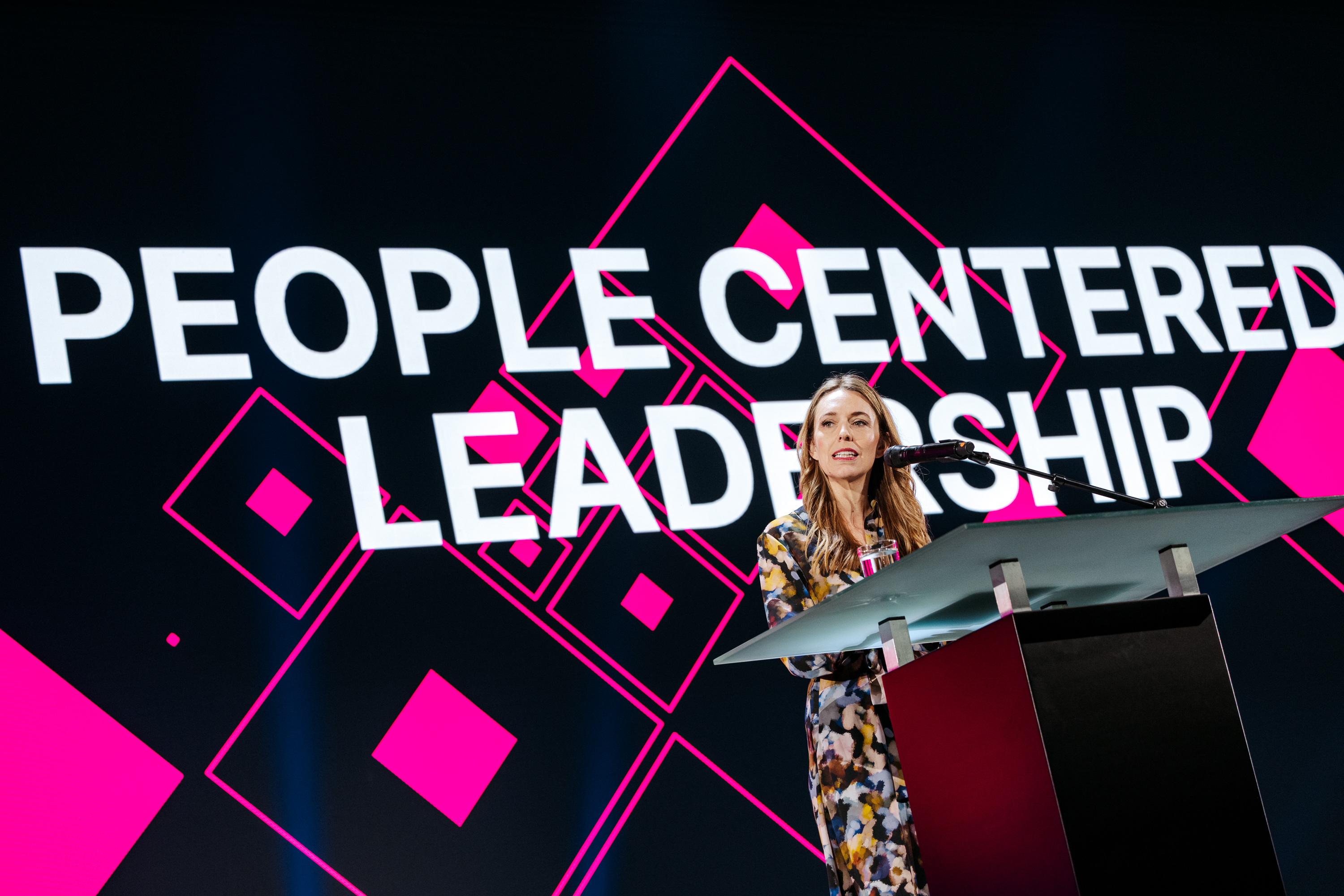
Block 1 was about the human role in digital organizations: digitalization and AI are transforming organizations at lightning speed, but it is still people who make the difference.
Diana Kander: "If you're the kind of person that addresses a problem with a to-do list, I just want the first three bullets of that list to be the names of people."
Serial entrepreneur, innovation expert, and New York Times bestselling author Diana Kander opened Block 1. She showed why curiosity is a crucial human skill that AI can never replace, and which daily habits train your curiosity muscle.
Diana coined the phrase "never goal alone" and she tested it on herself. She set out to do a single pull-up, found 35 women online who wanted the same thing, and recruited Misty Posey of the US Marine Corps, who had written her master's thesis on how women should train for them. Then came breast cancer. Her instinct was the one she had relied on since arriving in the US as a refugee: handle it alone. Letting the group in is what got her through the year, and the day before surgery she did ten pull-ups.
So here's the lesson for you: next time you write a to-do list for something hard, make the first three items names, not tasks. One person to think it through with, one for a different perspective, one to hold you to it.
Seth Godin: "You do not want to work for an AI, because it will push you around in ways that will not make you happy. The alternative is to get an AI to work for you."
Seth Godin, author of more than 20 bestsellers and a living legend in marketing and leadership, closed Block 1. He made the case for why our uniquely human qualities (creativity, empathy, and initiative) matter more than ever in a world of algorithms.
Here's the thing: somebody is setting the pace of your workday, and it may not be you. Bosses are racing to adopt AI, Seth says, because they are in love with deskilling: take the talent of your best people, bake it into the system, then hire people who are less picky about where they work. The pitch sounds flattering. You get to be a centaur, human brain on top, superpowered machine underneath. In most companies it lands the other way around, with the machine handing out the work while you keep up. And nobody, as Seth put it, wants to grow up to be an Amazon driver.
So here's the lesson for you: list everything you did yesterday, then mark every item you could fully describe in writing to somebody else. That is the part a computer will do cheaper than you, so hand it over on your terms, before somebody hands it over for you. Spend the hours you get back on one project you own from start to finish. That is the difference between being a landlord and a tenant, and right now it is also the difference between leading and being led.
Block 2: human leadership: empathy over dominance
Block 2 was about human leadership: the era of dominant leadership is over. People centered leaders are kind, connecting, and compassionate.
Ahmed Aboutaleb: "Investing in cables, bridges, waterways, wonderful buildings and skyscrapers is not enough to make a strong city. The strength of the city is measured by the strength of the people."
Ahmed Aboutaleb, former mayor of Rotterdam and one of Europe’s most respected political leaders, opened Block 2. He showed how humanity, inclusivity, and vision can guide leadership, even in times of tension and polarization.
Ahmed ran a city of 675,000 people and 175 nationalities, and he decided early that concrete would not hold it together. So he went out: 136 times he left the city hall, which Rotterdammers call the palace, because citizens were never going to walk into it. His cheapest and most effective policy instrument turned out to be dinner. The city paid, the neighborhood cooked, and he took his jacket off alongside his senior officials and listened to what hurt.
So here's the lesson for you: count how many times last year you went to where your people actually work, instead of having them come to you. If the number embarrasses you, put the first three visits in your calendar this week. And leave the presentation at home.
The Rt. Hon. Dame Jacinda Ardern: "The characteristics we deploy in troubled times should be defined by the humanity we bring to leadership at all times: proximity, curiosity, empathy, and action."
Jacinda Ardern, former Prime Minister of New Zealand, closed Block 2. She showed that you can be strong and empathetic at the same time, and that consensus often builds more lasting results than conflict.
Jacinda gets asked about crisis leadership constantly. No wonder: in one term she faced a disease ripping through the national herd, a terror attack, a volcanic eruption, and a pandemic. Her answer? There is no crisis mode. Crisis and change are the new constant, so the traits you reach for on your worst day should be running every ordinary day too. Proximity: get closer to the problem, not further away. Curiosity: admit what you don't know yet. Empathy: treat how people feel as information, not as noise. Action: prove it. And yes, those are exactly the qualities we praise in our children, and exactly the ones we stop expecting from professionals.
So here's the lesson for you: name the one thing you only do when things go badly wrong. Maybe you finally walk the floor, maybe you say the honest thing, maybe you decide in a day instead of a quarter. Put it in next week's calendar, while nothing is on fire. That is the whole difference between a leader with a crisis mode and a leader people already trust when it hits.
Block 3: building human centered organizations
Block 3 was about building organizations where people genuinely come first, and what that means for the way you deal with customers, investors, and employees.
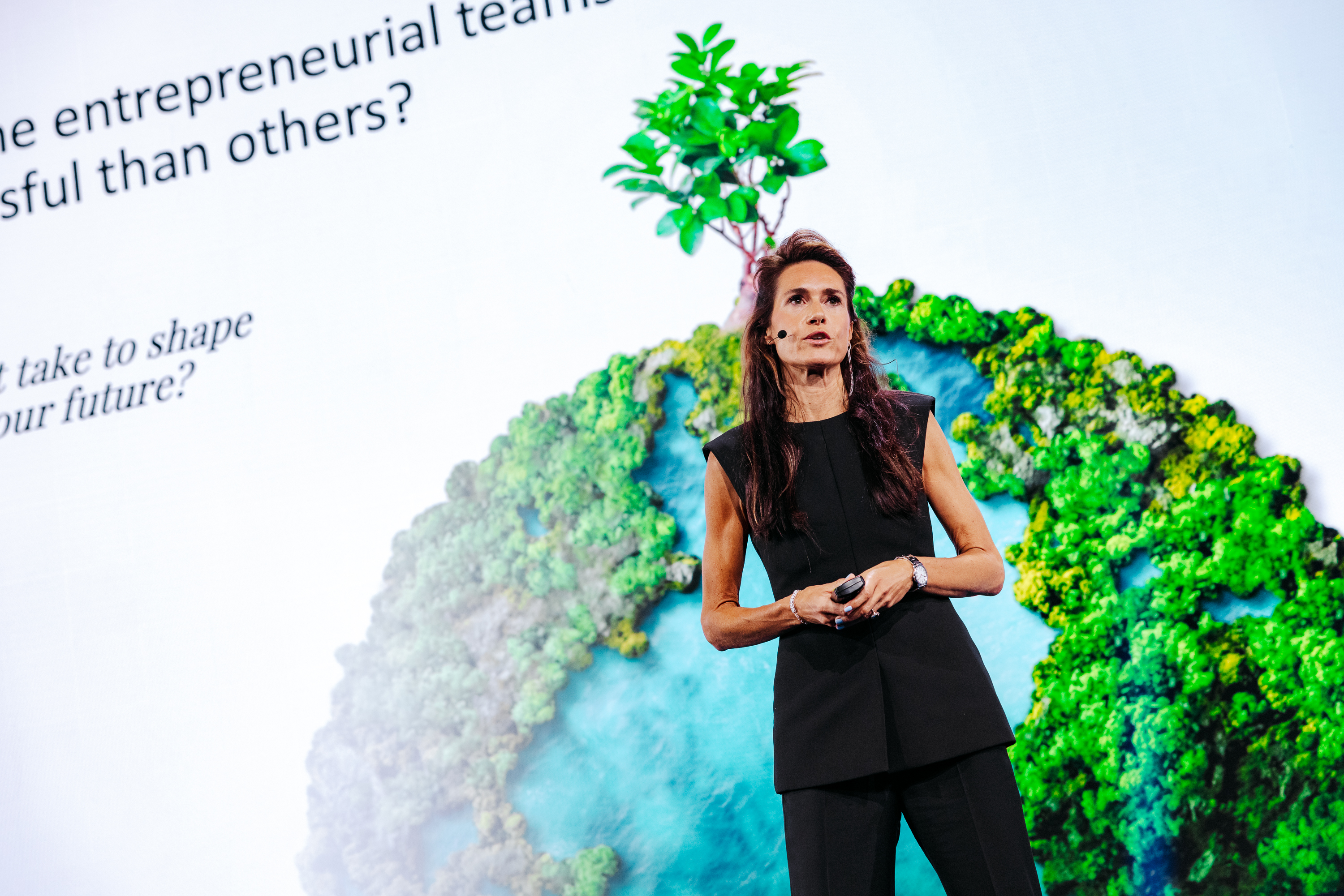
Eva de Mol: “Nine out of ten companies actually fail. [...] If we look at those failures, we actually find that 60% is due to the team. Not the product, not the market. It's really this team."
Leading tech investor, scientist, and author Eva de Mol opened Block 3. She shared insights from the world of innovative startups: how do you build companies that use technology wisely and keep people at the center?
Eva spent years on one question: why do some ventures succeed while others, with the same market and the same product, do not. Her PhD research at Berkeley followed more than a thousand entrepreneurial teams over five years, and the answer turned out to be uncomfortable for anyone who loves a good business plan. Most innovation fails, and most of that failure traces back to the people, not the idea. Her advice to the room was blunt: whatever you are working on, go look at the team first.
So here's the lesson for you: take the innovation project you care most about and spend your next review on the team instead of the roadmap. Who complements whom, who is missing, and who is only there because you like working with them?
Robin Achterkamp: "We don't hire people to make lunch. We make lunch so we can hire people."
Robin Achterkamp, social entrepreneur, founder of Lunch Bunch, and a champion for people who face barriers to employment, was the surprise of the day. He was not on the program: Ikenna brought him on just before the final speaker, because the team had heard his story and decided it deserved this stage. Robin used those minutes to tell the room what judgment costs, starting with the night he stood on a tenth-floor ledge, and ending with a business built on the opposite instinct.
The turning point came years later, when he hired a man named Ruud, whose energy was so overwhelming that everyone around him kept telling him to calm down. Robin saw a delivery rider, and Ruud was so full of energy he would switch off the battery on the electric bike and power through Rotterdam on muscle alone. He was happy, Robin says, because someone finally saw him for who he was. That became the principle behind Lunch Bunch, now growing across Rotterdam, with The Hague this year and Amsterdam next: "We don't judge, we see and we help." And Robin is honest about how hard that is, because judging is ancient equipment. In a small tribe, misjudging a stranger could get you killed. The instinct never left. It just moved from the tribe to the boardroom.
So here's the lesson for you: think of the last person you passed over for being too much. Too loud, too intense, too odd, not a culture fit. Then ask Robin's question honestly: was that about them, or about the meeting you were late for and the version of yourself you weren't happy with that day? Some of your best hires are in that pile right now.
Steven Bartlett: "If you scale down the size of the goal, you scale up the motivation."
Entrepreneur, investor, and host of the #1 podcast The Diary of a CEO, Steven Bartlett closed the day. He shared what he has learned about culture, teams, and purpose: why people stay, grow, and contribute. And why people centered organizations not only take better care of their employees, but are also more successful in the long run.
Big goals sound inspiring. But wins that big are so rare, Steven says, that chasing them demoralizes a team. Small wins do the opposite. His friend Sir Dave Brailsford turned British cycling from a laughingstock into the best team in the world with marginal gains, and those tiny improvements changed the riders' mindset. People stopped going home at 5 p.m. and started working until 1 a.m., because "they felt like they were going somewhere." Yet most leaders still believe a pay raise motivates more.
So here's the lesson for you: stop setting goals so big that nobody can finish anything before the quarter ends. Cut them into pieces small enough to complete this week, and then make the finishing visible. A round of applause for a tiny improvement is the cheapest motivator you own, and your competitors think it's too petty to bother with.
7 speakers, 7 quotes—and a brand-new Business Forum next year!
That’s it for today. Over the next few days we’ll publish an in-depth blog on every speaker. Including the VIP session with Jacinda Ardern. We’ll share them in our follow-up emails and on our website.
And yes: in 2027 we’re hosting the leadership event of the year once again!
On Friday, September 24, at Ahoy Rotterdam. The theme: REINVENT. Because reinventing yourself is the skill of our time.
The first speakers are already confirmed:
🔥 Oprah Winfrey (whoop whoop!) – media icon, self-made entrepreneur, and our biggest booking since Obama
🔥 Pieter Zwart – founder and CEO of Coolblue
🔥 Rafah Harfoush – AI advisor to the United Nations and the French government
🔥 Philippe Aghion – Nobel laureate in economics
Will you be there?
Everything about Business Forum 2027 and the Super Early Bird tickets